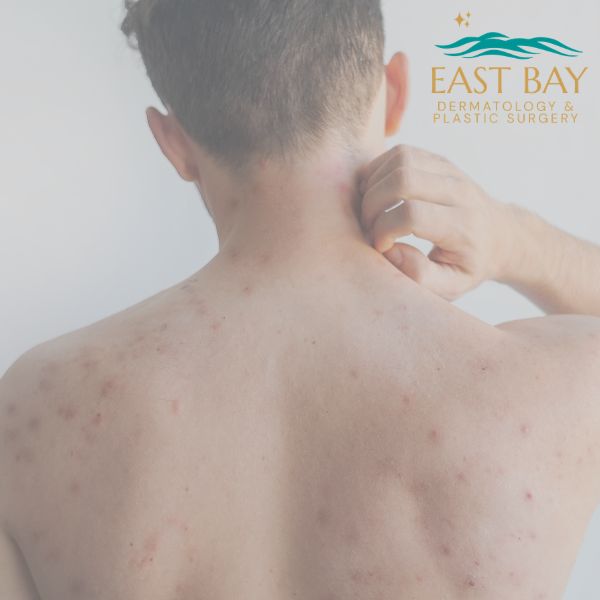
Why It Matters to Tell the Difference
Eczema and psoriasis can look remarkably similar — both produce red, inflamed patches of skin — but they respond to very different treatments. Using the wrong treatment can prolong discomfort or even worsen symptoms.
At East Bay Dermatology & Plastic Surgery in Bellmore, NY, we evaluate patients with chronic skin conditions every day. Getting an accurate diagnosis is the first step toward lasting relief.
What Is Eczema?
Eczema, also known as atopic dermatitis, is a chronic inflammatory skin condition affecting roughly 1 in 10 people in the United States. It’s caused by a combination of genetic and environmental factors that disrupt the skin’s barrier function, leading to inflammation and intense itching.
Common eczema characteristics:
- Intense itching (often the most prominent symptom)
- Red, inflamed, sometimes oozing or crusted patches
- Patches in skin folds — inside elbows, behind knees, neck, wrists, ankles
- Dry, sensitive skin that worsens with certain triggers
- Often begins in childhood, though adult-onset eczema is increasingly common
Triggers commonly seen in Long Island patients:
- Seasonal humidity shifts (dry winters, humid summers)
- Pollen and grass allergies
- Stress
- Certain fabrics, soaps, or detergents
- Sweating
For patients managing this condition, we offer personalized eczema treatment in Bellmore.
What Is Psoriasis?
Psoriasis is a chronic autoimmune condition in which the immune system mistakenly signals skin cells to multiply at an accelerated rate. Normal skin cells turn over every 28-30 days; in psoriasis, they turn over every 3-5 days, building up into thick, scaly plaques.
Common psoriasis characteristics:
- Thick, raised, well-defined plaques with silvery-white scales
- Most often appears on elbows, knees, scalp, and lower back
- Itching is typically less severe than eczema, though some patients experience burning or soreness
- May be accompanied by joint pain (psoriatic arthritis affects up to 30% of psoriasis patients)
- Often has a more sharply defined edge between affected and unaffected skin
- Frequently develops in early adulthood, though it can appear at any age
We provide tailored psoriasis treatment designed to manage flare-ups and restore comfort.
Eczema vs. Psoriasis — Side-by-Side Comparison
| Feature | Eczema | Psoriasis |
|---|---|---|
| Cause | Genetic + environmental; skin barrier dysfunction | Autoimmune |
| Itching | Intense | Mild to moderate |
| Appearance | Red, inflamed, sometimes oozing | Thick plaques with silvery scales |
| Typical location | Skin folds (inner elbows, behind knees) | Outer elbows, knees, scalp, lower back |
| Edge of patches | Diffuse, blends into healthy skin | Sharp, well-defined |
| Age of onset | Often childhood | Often early adulthood |
| Associated conditions | Asthma, allergies, hay fever | Psoriatic arthritis, cardiovascular risk |
How a Skin Condition Is Diagnosed
A skin evaluation typically distinguishes the two conditions through:
- Visual examination — Location, pattern, scale type, and texture of the patches
- Medical history — Age of onset, family history, triggers, associated symptoms
- Skin biopsy (when needed) — A small skin sample examined under a microscope can confirm the diagnosis when the presentation is unclear
Some patients may have both conditions simultaneously, or a less common variant like seborrheic dermatitis, contact dermatitis, or pityriasis rosea — which is why professional evaluation matters.
Treatment Approaches Differ
Eczema treatment typically focuses on:
- Repairing the skin barrier with daily moisturizers
- Identifying and avoiding personal triggers
- Topical corticosteroids to reduce inflammation during flare-ups
- Newer prescription topicals like calcineurin inhibitors
- For severe cases, systemic medications or biologics
Psoriasis treatment typically focuses on:
- Slowing the rapid skin cell turnover
- Reducing inflammation
- Topical treatments (corticosteroids, vitamin D analogs, retinoids)
- Phototherapy (light therapy) for moderate cases
- Biologics and systemic medications for moderate-to-severe disease
Because the treatments differ significantly, getting the right diagnosis is essential to getting effective relief.
When to See a Skin Specialist on Long Island
Schedule an appointment if you experience:
- Persistent red, scaly, or itchy patches that don’t resolve with over-the-counter treatment
- Skin patches that interfere with sleep, work, or daily life
- Signs of infection (warmth, swelling, pus)
- Joint pain alongside skin symptoms
- Sudden worsening of an existing condition
East Bay Dermatology & Plastic Surgery treats patients across Bellmore, Merrick, Wantagh, Massapequa, Smithtown, and the wider Long Island community.
Call (516) 308-7070 or request an appointment online for an evaluation.
Frequently Asked Questions
Q: Can you have both eczema and psoriasis at the same time?
Yes, though it’s less common. Some patients have both conditions simultaneously, or develop one later in life after having the other since childhood. A professional skin evaluation can identify whether one or both conditions are present.
Q: Is eczema or psoriasis contagious?
Neither condition is contagious. You cannot catch eczema or psoriasis from another person — they are immune-related conditions, not infections.
Q: Can stress trigger eczema or psoriasis flare-ups?
Yes. Stress is a well-documented trigger for both conditions. Many patients notice flare-ups during high-stress periods, illness, or major life changes.
Q: Do eczema and psoriasis ever go away on their own?
Both are chronic conditions that typically come and go in cycles of flare-ups and remission. While symptoms can clear for extended periods, the underlying condition usually remains. Long-term management is often necessary.
Q: How long does it take to diagnose eczema or psoriasis?
Most cases can be diagnosed during a single in-office visit based on visual examination and medical history. If the presentation is unclear, a small biopsy may be performed, with results typically available within 7-10 days.