You made it through your teenage years, so why are you still breaking out? If you’re dealing with pimples in your 20s, 30s, 40s, or beyond, you’re far from alone. Adult acne is one of the most common reasons people visit a dermatologist, and it affects women especially often.
The good news is that adult acne is very treatable. Below, the team at East Bay Dermatology & Plastic Surgery explains what causes adult breakouts, why drugstore products often aren’t enough, and how a dermatologist can help you get clearer skin.
What Adult Acne Looks Like
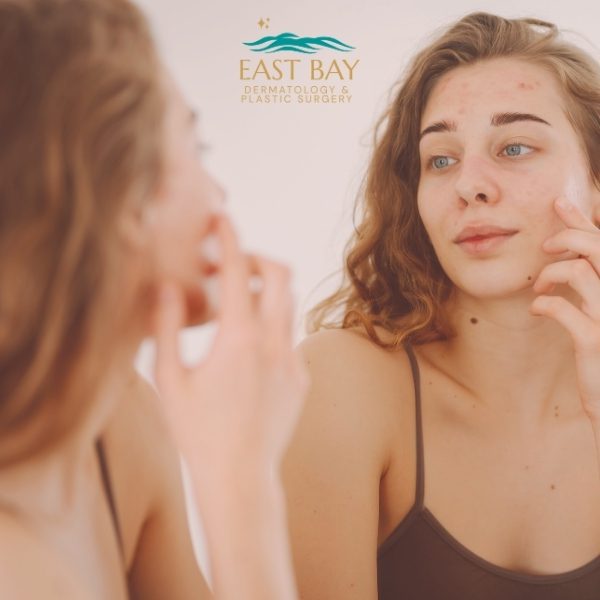
Adult acne often looks different from the acne you had as a teenager. Teen breakouts tend to cluster on the forehead, nose, and other oily areas. Adult acne, particularly in women, more often shows up on the lower face: the jawline, chin, and around the mouth.
Adult breakouts also tend to be deeper and more inflamed. Instead of mostly blackheads and whiteheads, many adults get tender red bumps or cysts under the skin that linger for weeks. These deeper blemishes are also more likely to leave behind dark spots or scars.
Adult acne can also show up alongside other signs of aging, like fine lines or uneven tone. Many acne products are drying or irritating, so treating acne and aging skin at the same time takes some balance.
Why Adult Acne Happens
All acne starts the same way: oil (sebum) and dead skin cells clog a pore, acne-causing bacteria build up, and inflammation follows. What differs in adults is what sets that process in motion. Common triggers include:
- Hormonal changes. Shifts in hormones around the menstrual cycle, pregnancy, perimenopause, and menopause can increase oil production. Starting or stopping birth control can also trigger breakouts.
- Underlying conditions. Polycystic ovary syndrome (PCOS) and other hormonal conditions can cause persistent acne, often along with irregular periods or excess hair growth.
- Stress. Stress hormones can increase oil production and worsen inflammation, which is why breakouts often flare during busy or difficult stretches.
- Skin and hair products. Heavy moisturizers, makeup, sunscreens, and hair products can clog pores. Look for labels that say “non-comedogenic” or “won’t clog pores.”
- Medications. Some medications, including corticosteroids, lithium, and certain anticonvulsants, can cause acne as a side effect. Never stop a prescribed medication without talking to your doctor.
- Family history. If a parent or sibling had adult acne, you may be more likely to have it too.
- Diet. Research suggests that high-glycemic foods (like white bread and sugary snacks) and dairy may worsen acne for some people, though the link varies from person to person.
Often, more than one of these factors is at play. A dermatologist can help pinpoint what’s driving your breakouts.
Why Over-the-Counter Products Often Aren’t Enough
Drugstore cleansers and spot treatments with benzoyl peroxide or salicylic acid can help mild breakouts. But many adults find these products don’t go far enough, for a few reasons.
First, most over-the-counter products work mostly on the surface. They can’t address hormonal acne at its source, and they’re often too weak for deep, inflamed cysts. Second, adult skin tends to be drier and more sensitive than teenage skin. Using several harsh products at once can lead to redness, peeling, and irritation, which can make skin look worse. Finally, it’s easy to spend months cycling through products without real progress, while new breakouts keep leaving marks behind.
If you’ve used over-the-counter treatments consistently for two to three months without meaningful improvement, it’s a good time to see a dermatologist.
How a Dermatologist Treats Adult Acne
A dermatologist starts by examining your skin and asking about your health history, products, medications, and menstrual cycle if relevant. From there, they build a treatment plan around your acne type and what’s causing it. Depending on your needs, that plan may include:
- Prescription topical treatments. Retinoids such as tretinoin help unclog pores, prevent new clogs from forming, and smooth texture and fine lines. Other options include azelaic acid, topical antibiotics, and prescription-strength benzoyl peroxide.
- Oral antibiotics. For moderate to severe inflammatory acne, a short course of an oral antibiotic like doxycycline can calm inflammation. These are usually paired with topical treatments and used for a limited time.
- Hormonal therapy. For women with hormonal acne, spironolactone or certain birth control pills can reduce the hormone-driven oil production behind jawline and chin breakouts.
- Isotretinoin. For severe, cystic, or scarring acne that hasn’t responded to other treatments, isotretinoin (formerly sold as Accutane) can produce long-lasting results. Your dermatologist must monitor it closely.
- In-office treatments. Chemical peels, professional extractions, and medical-grade facials can clear clogged pores and boost your at-home routine. For a painful cyst, a cortisone injection can shrink it within a few days.
Most acne treatments take about 8 to 12 weeks to show their full effect, so consistency matters. Your dermatologist will check in on your progress and adjust your plan as your skin responds.
What About Acne Scars and Dark Spots?
Even after breakouts clear, they can leave marks behind. Flat dark or red spots (post-inflammatory hyperpigmentation) often fade on their own over several months, and topical treatments and regular sunscreen can speed that up. True scars, like indented “pitted” scars, are permanent changes in the skin’s texture and usually need in-office treatment to improve.
The best way to prevent scarring is to treat acne early and resist picking or squeezing blemishes. If you already have scars or lingering discoloration, ask your dermatologist which treatments may help once your active acne is under control.
When to See a Dermatologist
You don’t need to wait until acne is severe to get help. Consider booking an appointment if:
- Over-the-counter products haven’t helped after two to three months.
- You get deep, painful bumps or cysts.
- Your breakouts are leaving dark spots or scars.
- Acne started suddenly in adulthood, or comes with irregular periods or unusual hair growth.
- Your skin is affecting your confidence or quality of life.
Acne can also be confused with other skin conditions, like rosacea or perioral dermatitis, which need different treatment. A dermatologist can make sure you’re treating the right thing.
Get Help for Adult Acne on Long Island
At East Bay Dermatology & Plastic Surgery, our dermatology providers create personalized acne treatment plans for patients of all ages. We take the time to understand what’s causing your breakouts and clearly explain your options. When your results are in, you’ll hear from a real person, not an automated system. We can also pair your medical treatment with med spa and facial services to help your skin look its best.
We have three convenient Long Island locations:
- Bellmore: 2307 Bellmore Ave, Unit B, Bellmore, NY 11710
- Massapequa: 1035 Park Blvd, Massapequa, NY 11762
- Smithtown: 290 E Main St, Suite 700, Smithtown, NY 11787
Call (516) 308-7070 or contact us online to schedule your appointment. Learn more about our dermatology services and medical spa treatments.