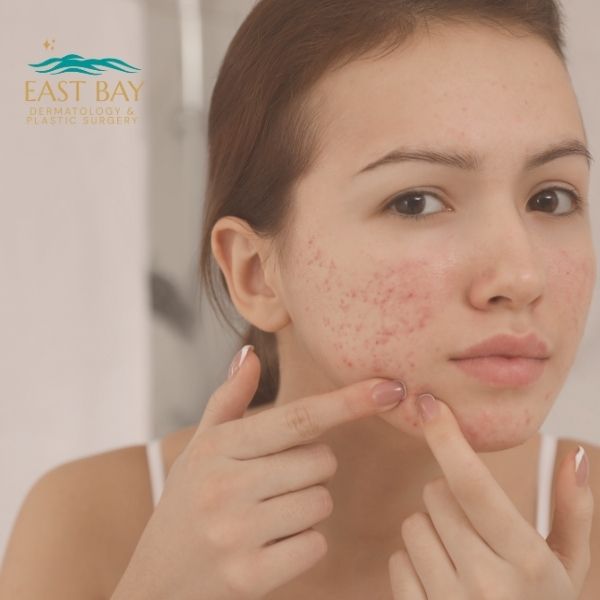
There’s a particular kind of frustration that comes with acne that won’t quit. You’ve used benzoyl peroxide and salicylic acid. You’ve been on a retinoid, probably an antibiotic, maybe spironolactone or a birth control pill. You’ve changed pillowcases, cut dairy, and spent more than you’d like to admit on products that promised something.
And you’re still breaking out.
For a long time, the next conversation was isotretinoin — Accutane — and for many people that’s still the right answer. But there’s now a genuinely different option, and it’s the first of its kind: a laser that treats acne by targeting the structure in your skin that actually causes it.
What AviClear Actually Does
Acne starts in the sebaceous gland, the small oil-producing gland attached to each hair follicle. When those glands overproduce, pores clog, bacteria multiply, inflammation follows, and you get a breakout. Every acne treatment you’ve tried works somewhere along that chain — unclogging pores, killing bacteria, calming inflammation, or dialing back the hormones that drive oil production.
AviClear goes after the gland itself.
It’s a 1726 nm laser, a wavelength chosen because it’s absorbed by the lipids — the oil — inside the sebaceous gland. The energy heats and specifically suppresses those glands, while a contact cooling system protects the skin’s surface. Biopsy studies have confirmed what the wavelength is designed to do: the sebaceous gland is affected while the epidermis and the follicle lining are left intact.
Less oil production means fewer clogged pores, which means fewer breakouts — not covered up or managed day-to-day, but reduced at the source.
In March 2022, AviClear became the first laser cleared by the FDA to treat mild, moderate, and severe inflammatory acne vulgaris.
This is Not the Same as Other Acne Lasers
If you’ve had blue light, red light, or IPL for acne, this is an entirely different mechanism of action. Those treatments largely target bacteria or inflammation — useful, but temporary, because the gland producing the oil is untouched and keeps producing.
Targeting the gland is what makes AviClear structurally different, and it’s also why the results behave differently over time, which we’ll come back to.
How it Compares to Accutane
This is the comparison most people are actually making, so let’s be direct about it.
They aim at the same target. Isotretinoin also works by shrinking sebaceous glands and reducing oil production. That shared mechanism is precisely why AviClear is a real alternative rather than a lesser substitute.
The difference is systemic versus local. Isotretinoin is an oral medication that affects your entire body. That’s why it comes with monthly blood work, enrollment in the iPLEDGE program, strict pregnancy prevention requirements, and a list of side effects that includes severe dryness, joint aches, and mood changes that need monitoring. For a lot of people, none of that is a dealbreaker. For plenty of others — anyone who is pregnant, planning a pregnancy, breastfeeding, on medications that interact, or simply unwilling to take a systemic drug for a skin condition — it rules the option out.
AviClear is three laser appointments: nothing systemic, no lab monitoring, no pregnancy restrictions, no drug interactions.
Accutane still has the deeper evidence base and, for the most severe nodulocystic acne, remains the most powerful tool available. Anyone who tells you a laser has replaced isotretinoin is overselling. What’s true is that there’s now a credible option for the large group of people for whom Accutane isn’t appropriate, isn’t tolerable, or isn’t something they’re willing to do.
What the Research Actually Shows
In the trial that led to FDA clearance, 104 patients — nearly all with moderate or severe acne at the start — received three treatments spaced a few weeks apart. The results- and this is the part worth reading carefully:
At three months, about 80% of patients had at least a 50% reduction in inflammatory lesions, and roughly 36% were rated clear or almost clear.
At one year, those figures had risen to about 92% and 66%, respectively. Median inflammatory lesion reduction went from roughly 56% at three months to about 79% at a year.
That upward trend is the most important thing to understand about this treatment, and we’ll return to it in a moment.
On safety, follow-up through 52 weeks found side effects were mostly mild, temporary, and self-resolving, with no reports of blistering, scarring, or lasting changes in skin pigmentation.
And the honest caveat. When the American Academy of Dermatology updated its acne guidelines in 2024, it rated the evidence for laser and light-based devices as insufficient to make a formal recommendation — specifically because the 1726 nm laser hasn’t yet been studied in a randomized controlled trial. The results above come from real prospective studies with real follow-up, and they’re encouraging. But they aren’t the gold-standard trial design, and it would be dishonest to present them as such.
We’d rather tell you that than have you find it out later. It’s also exactly the sort of thing worth discussing at a consultation, where the question isn’t “is this treatment good” but “is this treatment right for your acne?”
What Treatment is Actually Like
Three sessions, spaced a few weeks apart. About 30 minutes each. No numbing cream, no downtime, and you can go back to work or the gym the same day.
The sensation is usually described as brief snaps of heat, each followed immediately by the cooling plate against your skin. Most people find it very manageable. Afterward, the treated skin may look flushed for a few hours, similar to a mild sunburn.
That’s the whole commitment—three appointments over roughly two months.
The Timeline Nobody Warns You About
Here’s where expectations matter more than anything else in this article.
AviClear does not work quickly, and it is not supposed to. Many patients see little change during the treatment series itself. Some see a temporary flare-up, sometimes called purging, in the first weeks.
The improvement builds over months, because you’re waiting on suppressed oil glands to change how your skin behaves — not on a cream to clear an existing pimple. That’s exactly why the 12-month trial numbers are better than the 3-month numbers.
If you judge this treatment at week six, you will conclude it didn’t work. If you give it six to twelve months, the data says you’ll most likely think something quite different. Anyone considering AviClear needs to hear that up front, and any practice that doesn’t say so is setting you up for disappointment.
It Works for All Skin Tones — Which Hasn’t Always Been True
Historically, many laser treatments posed real risks for patients with deeper skin tones because lasers that target pigment can cause unwanted lightening or darkening.
AviClear targets oil, not pigment. It’s FDA-cleared as safe for all skin types and tones, and the year-long safety follow-up reported no pigmentation changes across a diverse group of patients. For anyone who has been told they’re not a candidate for laser acne treatment because of their skin tone, this is worth a conversation.
Who’s a Good Candidate?
AviClear tends to be a strong fit if you have persistent inflammatory acne, have already tried topicals and orals without lasting success, can’t take or don’t want to take isotretinoin, are pregnant or planning a pregnancy, or want to stop building your life around a daily prescription routine.
Interestingly, adult women make up the majority of patients treated in experienced practices, and they appear to respond especially consistently — which fits what we see clinically, since adult acne is disproportionately a women’s health issue.
It’s likely not the right first step if you’ve never tried anything at all. Well-chosen topical treatment clears a lot of acne, and it’s the sensible place to begin.
It Doesn’t Have to be Either/Or
One point that gets lost in the marketing: AviClear is not necessarily a replacement for everything else. Clinicians with the most experience using it report the best outcomes when it’s combined with medical therapy rather than used in isolation.
That’s the advantage of having this treatment inside a full dermatology practice rather than at a standalone med spa. We can put you on AviClear and manage your topicals, adjust your hormonal therapy, treat the post-acne marks and scarring left behind, and change course if your skin doesn’t respond the way we expect. A laser on its own is a device. A laser plus a dermatologist managing your whole case is a treatment plan.
Where to Start
If acne has outlasted everything you’ve thrown at it, the useful next step isn’t picking a treatment — it’s finding out what’s actually driving your breakouts. At East Bay Dermatology & Plastic Surgery, our board-certified dermatologists will assess your skin, review what you’ve already tried and how your skin responded, and give you a straight answer about whether AviClear is a good fit, whether something else would serve you better, or whether a combination makes the most sense.
We see patients in Bellmore, Massapequa, and Smithtown, serving Nassau and Suffolk County. Contact us today to start your journey towards clear skin.