If you’re tired of the endless cycle of shaving, waxing, and plucking, you’ve probably wondered whether laser hair removal actually works — and how it works in the first place. It’s one of the most popular cosmetic treatments in the country, but there’s a lot of confusion about what it does, whether it hurts, and how many sessions you’ll really need.
This complete guide breaks down the science in plain language, walks through what to expect, and explains how to get safe, effective results. And if you’re considering laser hair removal in Bellmore, NY, the board-certified team at East Bay Dermatology & Plastic Surgery is here to help you decide whether it’s right for you.
The Short Answer: How Laser Hair Removal Works
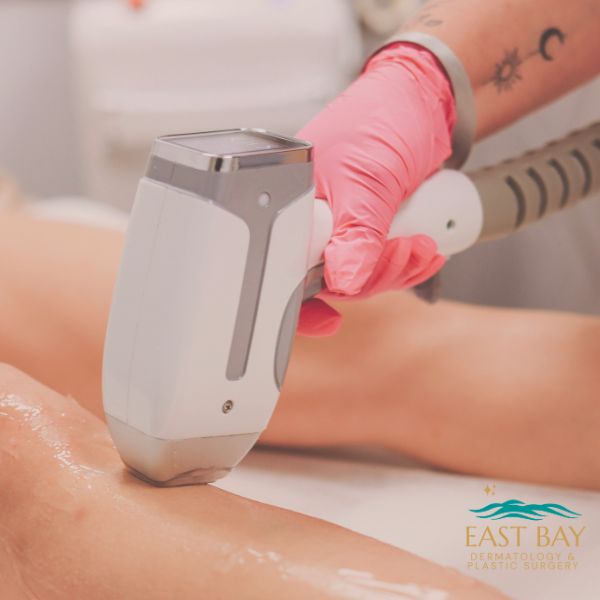
Laser hair removal works by using a concentrated beam of light to target the pigment (melanin) in your hair follicles. The light is absorbed by that pigment and converted into heat, and that heat damages the follicle enough to slow or stop it from growing new hair. In dermatology, this precise targeting is called selective photothermolysis — a fancy term for a simple idea: the laser heats the hair follicle while leaving the surrounding skin unharmed.
Because the treatment relies on pigment to work, it has traditionally been most effective on dark hair. The good news is that modern laser technology has expanded dramatically, and today’s devices can safely and effectively treat a much wider range of skin tones than the lasers of a decade ago.
The Science, Step By Step
Here’s what’s actually happening during a treatment:
- The laser emits a specific wavelength of light. That wavelength is chosen because melanin — the pigment in your hair — absorbs it well.
- The pigment in the follicle absorbs the light and heats up. The energy travels down the hair shaft to the root, where the follicle lives.
- The heat damages the follicle. This disrupts the follicle’s ability to produce new hair, without burning the skin around it.
- Cooling protects your skin. Most modern systems cool the skin’s surface before, during, or after each pulse, which both protects the skin and keeps you comfortable.
Why You Need More Than One Session
This is the part most people don’t realize: laser hair removal only works on hair that’s in its active growth phase.
Your hair doesn’t all grow on the same schedule. At any given moment, each follicle is in one of three stages — actively growing (anagen), transitioning (catagen), or resting (telogen). The laser can only effectively target follicles in the active growth phase, and only a portion of your hair is in that phase at once.
That’s why a series of treatments is necessary. By spacing sessions several weeks apart, each appointment catches a new group of follicles as they cycle into their active phase.
Most patients need six to eight sessions, typically spaced four to six weeks apart, to achieve their best results. The exact number depends on the treatment area, your hair color and thickness, and your individual hair-growth cycle — which is one reason a professional consultation matters.
Is Laser Hair Removal Permanent?
You’ll often hear laser hair removal described as “permanent,” but the most accurate term — and the one the FDA uses — is permanent hair reduction. After a full series of treatments, most people see a dramatic, long-lasting reduction in hair, and the hair that does regrow is usually finer and lighter.
Many patients choose to come in for occasional maintenance sessions once or twice a year to keep results looking their best, since hormones and other factors can reactivate dormant follicles over time.
Does Laser Hair Removal Hurt?
Most people are relieved to find it’s far more tolerable than they expected. The sensation is commonly described as a quick, warm snap — similar to a rubber band lightly flicking the skin. Built-in cooling technology makes each pulse much more comfortable, and a numbing cream can be applied beforehand for more sensitive areas.
Comfort also varies by body part: areas with thinner skin (like the upper lip or bikini line) tend to be more sensitive than areas like the legs or arms. Any mild redness or swelling afterward usually fades within a few hours to a day.
What Areas Can Be Treated?
Laser hair removal can be used almost anywhere you have unwanted hair, including the:
- Legs
- Underarms
- Bikini line and Brazilian area
- Face (upper lip, chin, and cheeks)
- Back and chest
- Arms
- Neck
Who is a Good Candidate?
The best way to know for sure is a consultation, but in general, laser hair removal works best when there’s contrast between hair and skin — and modern lasers have widened the range of candidates considerably. A few things to know:
- Hair color matters. Because the laser targets pigment, it works best on brown and black hair. It’s not effective on white, gray, or very light blond hair, which lacks enough pigment, and it’s less reliable on red hair.
- Skin tone is no longer a barrier it once was. Advanced laser systems can safely treat darker skin tones — but this is exactly where an experienced, medically supervised provider matters most, because the wrong device or settings on the wrong skin type can cause burns or pigment changes.
- A medical evaluation helps. Certain medications, skin conditions, and hormonal factors can affect your results, which is why being treated at a dermatology practice — rather than a walk-in spa — offers an extra layer of safety.
How to Prepare and What to Do Afterward
Before your session: Avoid plucking, waxing, or electrolysis for a few weeks beforehand, since the laser needs an intact follicle to target (shaving is fine — in fact, you’ll usually be asked to shave the area before your appointment). Stay out of the sun and avoid tanning, as tanned skin raises the risk of side effects.
After your session: Protect the treated skin from the sun and apply sunscreen diligently. It’s best to skip hot showers, saunas, and intense workouts for a day or so, and to avoid harsh skincare products on the area while it settles.
(For a full walk-through of your appointment, see our guide on what to expect during your first laser hair removal session.)
Why Choose a Medical Practice for Laser Hair Removal
Laser hair removal is a medical procedure, even though it’s often marketed as a quick spa service. The device, the settings, and the provider’s training all directly affect both your safety and your results — especially for the face, sensitive areas, and deeper skin tones.
At East Bay Dermatology & Plastic Surgery, laser hair removal is performed under the oversight of board-certified dermatologists, so your treatment plan is built around your skin, your hair, and your goals — with the safety of a medical setting behind every session.
Ready to Try Laser Hair Removal in Bellmore, NY?
Imagine skipping the razor for good. If you’re ready to explore laser hair removal in Bellmore, NY, the team at East Bay Dermatology & Plastic Surgery will evaluate your skin and hair, answer your questions, and design a plan to get you smooth, lasting results.
Call (516) 308-7070 or request a consultation online to get started. Learn more about our laser hair removal services and everything else we offer at our medical spa.
Frequently Asked Questions
How does laser hair removal work?
Laser hair removal uses a beam of light that’s absorbed by the pigment in your hair follicles and converted to heat. That heat damages the follicle so it produces less hair over time, while cooling technology protects the surrounding skin.
How many laser hair removal sessions will I need?
Most people need six to eight sessions, spaced about four to six weeks apart, because the laser only affects hair that’s in its active growth phase. Your exact number depends on the area, your hair, and your skin.
Does laser hair removal hurt?
Most patients describe it as a quick, warm snap, like a rubber band against the skin. Built-in cooling and optional numbing cream make it very tolerable, and any redness typically fades within hours.
Is laser hair removal permanent?
It provides permanent hair reduction — a dramatic, long-lasting decrease in hair, with any regrowth usually finer and lighter. Occasional maintenance sessions help keep results looking their best.
Can laser hair removal be done on darker skin tones?
Yes. Modern laser systems can safely treat a wide range of skin tones, but it’s especially important to be treated by an experienced, medically supervised provider to avoid burns or pigment changes.