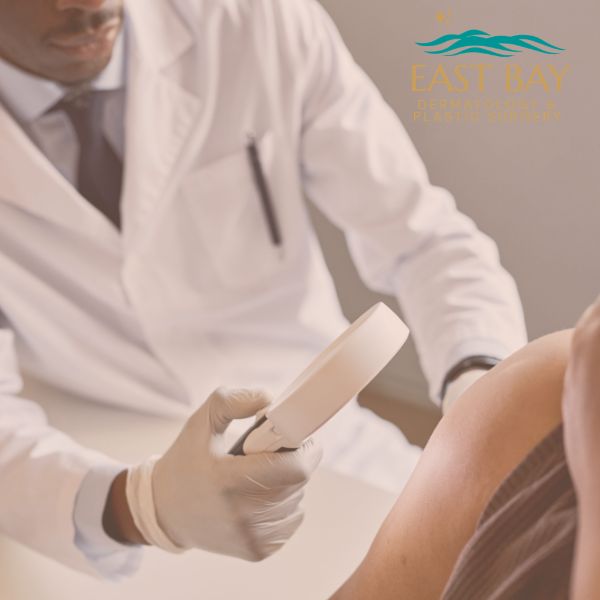
Why Early Detection of Melanoma Matters
Melanoma is the most serious form of skin cancer because it can spread to other parts of the body if left untreated. The good news: when detected early, melanoma is highly treatable.
At East Bay Dermatology & Plastic Surgery in Bellmore, NY, we screen patients across Nassau County and Long Island for early signs of skin cancer every day. Knowing what to look for between professional screenings can make a life-saving difference.
The ABCDEs of Melanoma — A Self-Check Framework
The ABCDE method is endorsed by the American Academy of Dermatology (AAD) as a self-examination guide for identifying potentially cancerous moles. Here’s what each letter stands for:
A — Asymmetry
Most benign (non-cancerous) moles are symmetrical — if you drew a line through the middle, the two halves would match. Melanomas are often asymmetrical, with one half looking different from the other.
B — Border
Healthy moles tend to have smooth, even borders. Melanomas often have irregular, ragged, notched, or blurred borders.
C — Color
Common moles are usually one shade of brown. Melanomas can show multiple colors — different shades of brown or black, or patches of pink, red, white, or blue.
D — Diameter
Melanomas are usually larger than 6 millimeters in diameter (about the size of a pencil eraser) when diagnosed, though they can be smaller. Any growing mole deserves attention regardless of size.
E — Evolving
This is often the most important sign. Any mole that is changing in size, shape, color, or elevation — or any new symptom like bleeding, itching, or crusting — warrants prompt evaluation.
Beyond the ABCDEs — Other Warning Signs to Watch For
The ABCDEs cover most melanomas, but skin cancer can appear in other ways. Schedule a skin appointment if you notice:
- A new growth that doesn’t look like your other moles (often called “the ugly duckling sign”)
- A sore that won’t heal after several weeks
- A spot that itches, bleeds, or feels tender
- A scaly, rough, or crusty patch that persists
- A pearly, waxy, or translucent bump
- Pigmentation that spreads beyond the border of a mole
- Changes under fingernails or toenails (dark streaks)
For patients with concerns, we offer comprehensive skin cancer screenings at our Bellmore location.
How to Perform a Monthly Skin Self-Exam
The AAD recommends performing a head-to-toe skin self-exam once a month. Here’s how:
- Stand in front of a full-length mirror in a well-lit room.
- Examine your face, ears, neck, chest, and torso.
- Check your arms, including the underside, between fingers, and under nails.
- Use a hand mirror to examine your back, the back of your neck, scalp, and buttocks.
- Sit down to check your legs, including the soles of your feet and between toes.
- Photograph anything questionable so you can track changes over time.
If anything looks suspicious or has changed since last month, schedule an annual skin screening or sooner appointment as needed.
Who Is at Higher Risk for Melanoma?
While anyone can develop skin cancer, certain factors increase your risk:
- Fair skin, light hair, or light eyes
- A history of sunburns, especially blistering sunburns
- Significant cumulative sun exposure or use of tanning beds
- A family or personal history of melanoma or other skin cancers
- Many moles (more than 50) or atypical moles
- A weakened immune system
Patients with higher risk factors may benefit from more frequent professional skin exams — sometimes every 3-6 months instead of annually.
Skin Cancer Care on Long Island
If you notice any ABCDE warning signs, a new or changing mole, or a suspicious spot that doesn’t heal, don’t wait for your annual screening — earlier evaluation means earlier treatment.
East Bay Dermatology & Plastic Surgery offers comprehensive skin cancer screenings, biopsies, and treatment for patients across Bellmore, Merrick, Wantagh, Massapequa, Smithtown, and the wider Long Island community.
Call (516) 308-7070 or request an appointment online to schedule your skin cancer screening.
Frequently Asked Questions
Q: What does the “E” in ABCDE stand for?
The “E” stands for Evolving. Any mole that is changing in size, shape, color, or elevation — or developing new symptoms like itching or bleeding — should be evaluated promptly.
Q: Can melanoma appear in areas not exposed to the sun?
Yes. While most melanomas develop in sun-exposed areas, melanoma can appear anywhere on the body — including the palms, soles, under the nails, and even in the mouth or eyes. This is why full-body professional screenings are important.
Q: How often should I check my skin for moles?
The American Academy of Dermatology recommends a monthly head-to-toe self-exam and an annual professional skin exam. Higher-risk patients may need more frequent professional screenings.
Q: Is every irregular mole melanoma?
No. Many irregular or asymmetric moles are benign (non-cancerous). However, only a professional skin exam — sometimes with the help of a biopsy — can definitively determine whether a mole is concerning. When in doubt, get it checked.
Q: What happens during a skin cancer screening?
A thorough head-to-toe examination is performed, often using dermoscopy to closely evaluate suspicious lesions. If anything appears concerning, a small biopsy may be performed in-office. Results are typically available within 7-10 days.