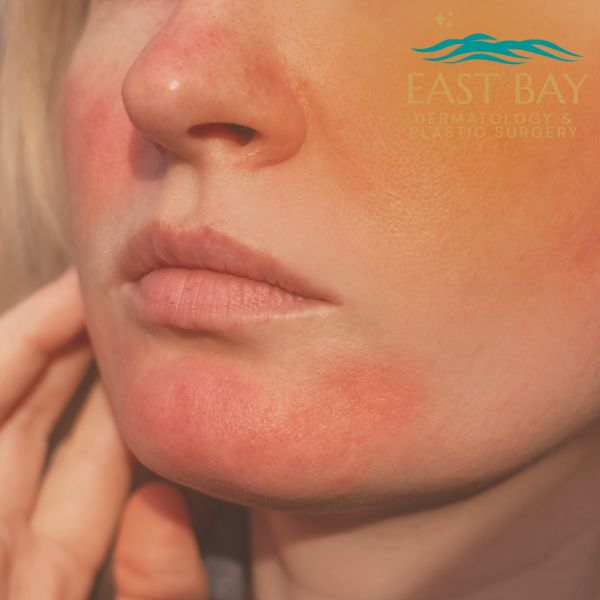
Rosacea is also unusually reactive to environment — and if you live on Long Island, your environment is working against you in ways that are specific enough to plan around. Here’s what’s driving your flares and what actually settles them down.
What Rosacea Actually Is
Rosacea is a chronic inflammatory condition of the facial skin, driven by a combination of an overactive immune response, dysregulated blood vessels, and in many patients an overgrowth of Demodex mites that normally live on the skin without causing problems. It typically shows up as persistent redness across the cheeks, nose, chin, and forehead, often with visible small blood vessels, flushing episodes, and in some patients acne-like bumps and pustules.
Modern dermatology treats rosacea by phenotype — meaning we treat the specific signs you actually have, rather than assigning you to a rigid subtype. Persistent redness, visible vessels, bumps, thickened skin, and eye involvement each respond to different therapies, and most patients have some combination.
Why Long Island Weather Is Hard on Rosacea
National Rosacea Society patient surveys found that close to 90% of respondents said their rosacea shifts with the seasons, and well over half reported summer as their worst stretch. Long Island delivers an unusually complete set of the triggers behind that pattern.
Humid Summers and Coastal Sun
Sun exposure consistently ranks as the single most common rosacea trigger in patient surveys — and coastal summers compound it. Sand and water reflect UV back at your face, so a day on the South Shore delivers more exposure than the same hours spent inland. Layer on high humidity, which keeps sweat from evaporating efficiently, and your body’s main cooling mechanism stalls. The result is sustained thermal flushing rather than a brief flush that resolves.
Cold, Windy Winters
Winter swaps one problem for another. Cold, dry air pulls moisture out of the skin barrier, and wind coming off the water accelerates it. A compromised barrier lets irritants in more easily and inflames more readily, which is why many patients who sail through July struggle in February — and vice versa.
Indoor Heat and Air Conditioning
The trigger patients most often overlook isn’t the weather outside, it’s the transition. Walking from 25-degree air into a forced-air-heated house, or from August humidity into aggressive air conditioning, produces exactly the rapid vascular response that rosacea skin handles poorly. Dry indoor heat all winter also steadily degrades the barrier in the background.
The Lifestyle Triggers That Compound It
Weather rarely acts alone. The triggers most consistently reported by patients include emotional stress, heavy exercise, alcohol, hot beverages, spicy food, hot baths and saunas, and certain skin care products — particularly alcohol-based toners, fragrance, and physical scrubs. Not every patient reacts to every item on a widely used checklist of common flare factors, which is exactly why blanket avoidance is the wrong strategy.
The goal is identifying your triggers, not eliminating all of them. In patient surveys, more than 90% of people who pinpointed and avoided their own personal triggers reported that their rosacea improved.
Rosacea vs. Acne: The Difference That Changes Treatment
Rosacea’s bumps and pustules get mistaken for acne constantly, and the mistake matters, because the products that help one frequently aggravate the other. Benzoyl peroxide, salicylic acid, and abrasive scrubs are reasonable tools for acne and often inflammatory for rosacea.
The clearest distinguishing sign is what’s missing: rosacea doesn’t produce comedones. If you have blackheads and whiteheads, you’re likely looking at acne, and treating adult acne takes a different approach entirely. Rosacea also centers on the mid-face and comes with background redness and flushing that acne doesn’t. Overlapping presentations are common enough that telling inflammatory skin conditions apart is a routine part of a dermatologic evaluation.
What Actually Helps
Prescription Treatment
Topical options include metronidazole and azelaic acid for inflammatory bumps, and ivermectin, which also addresses the Demodex component. For persistent background redness, topical vasoconstrictors such as brimonidine or oxymetazoline can reduce the flush directly. Oral antibiotics — most often doxycycline, including low-dose anti-inflammatory formulations that don’t act as antimicrobials — are used for moderate to severe inflammatory disease. Which of these fits depends on your specific signs, and it’s a decision that belongs in a medical dermatology visit rather than a guess at the pharmacy.
Laser and Light Therapy
Topicals do very little for visible blood vessels and fixed redness, because those aren’t inflammatory — they’re vascular. That’s where laser and light-based treatments come in: pulsed dye laser and intense pulsed light target the vessels themselves, reducing both individual visible vessels and diffuse background redness. Most patients need a short series, and results hold well with maintenance.
Daily Skin Care That Doesn’t Backfire
Keep it short. A fragrance-free gentle cleanser, a barrier-supporting moisturizer, and daily broad-spectrum SPF 30 or higher — mineral formulations with zinc oxide or titanium dioxide are generally better tolerated on rosacea-prone skin than chemical filters. Skip the toners, scrubs, and high-strength acids unless your dermatologist has specifically cleared them.
Don’t Overlook Ocular Rosacea
Rosacea affects the eyes in a substantial share of patients, and it’s routinely missed because people don’t connect the symptoms to a skin condition. Gritty or burning eyes, chronic dryness, redness along the lid margins, recurring styes, and light sensitivity all warrant mention at your appointment. Untreated ocular rosacea can affect the cornea, so it’s worth raising even if it seems unrelated to what’s happening on your cheeks.
Build a Trigger Diary
The most useful thing you can do before your first appointment costs nothing. For two weeks, note the date, what your skin did, and the conditions around it: temperature, sun exposure, what you ate and drank, exercise, stress, and any new products. Patterns surface fast, and they’re almost always more specific than the general trigger lists suggest. Bring it with you — it shortens the path to an effective plan considerably.
Rosacea Care in Bellmore, NY
Rosacea has no cure, but it responds well to management, and the difference between a patient who controls it and one who doesn’t usually comes down to getting an accurate diagnosis and a plan built for their specific signs and triggers. The dermatologists in Bellmore at East Bay Dermatology & Plastic Surgery evaluate patients across Bellmore, Merrick, Wantagh, Massapequa, Smithtown, and the wider Long Island area — with the prescription therapies and in-office laser treatment to address both the inflammation and the redness in one practice.
Call (516) 308-7070 to schedule an evaluation.
Frequently Asked Questions
What triggers rosacea flare-ups?
The most commonly reported triggers are sun exposure, emotional stress, hot and humid weather, wind, heavy exercise, alcohol, hot beverages, spicy food, hot baths, and harsh skin care products. Triggers are highly individual — most patients react strongly to only a few.
Does weather really affect rosacea?
Yes, and significantly. In patient surveys, close to 90% of people with rosacea reported that their condition changes with the seasons, and more than half said summer is their worst period.
Is rosacea the same as acne?
No. Both can produce bumps and pustules, but rosacea doesn’t cause blackheads or whiteheads, and it involves persistent facial redness and flushing that acne doesn’t. Many acne treatments irritate rosacea, which is why an accurate diagnosis matters before you start treating.
Can rosacea be cured?
No, but it can be controlled well. Most patients achieve long periods of clear or nearly clear skin with a combination of prescription therapy, trigger management, and laser treatment for persistent redness and visible vessels.
What sunscreen is best for rosacea?
A broad-spectrum mineral sunscreen with zinc oxide or titanium dioxide at SPF 30 or higher, fragrance-free. Mineral filters are generally better tolerated on rosacea-prone skin than chemical ones. Daily use matters, since sun is the most frequently reported trigger.
Does rosacea affect the eyes?
It can, in a meaningful share of patients. Gritty, burning, dry, or light-sensitive eyes and inflammation along the eyelid margins are common signs of ocular rosacea and should be mentioned at your appointment, since untreated cases can affect the cornea.